
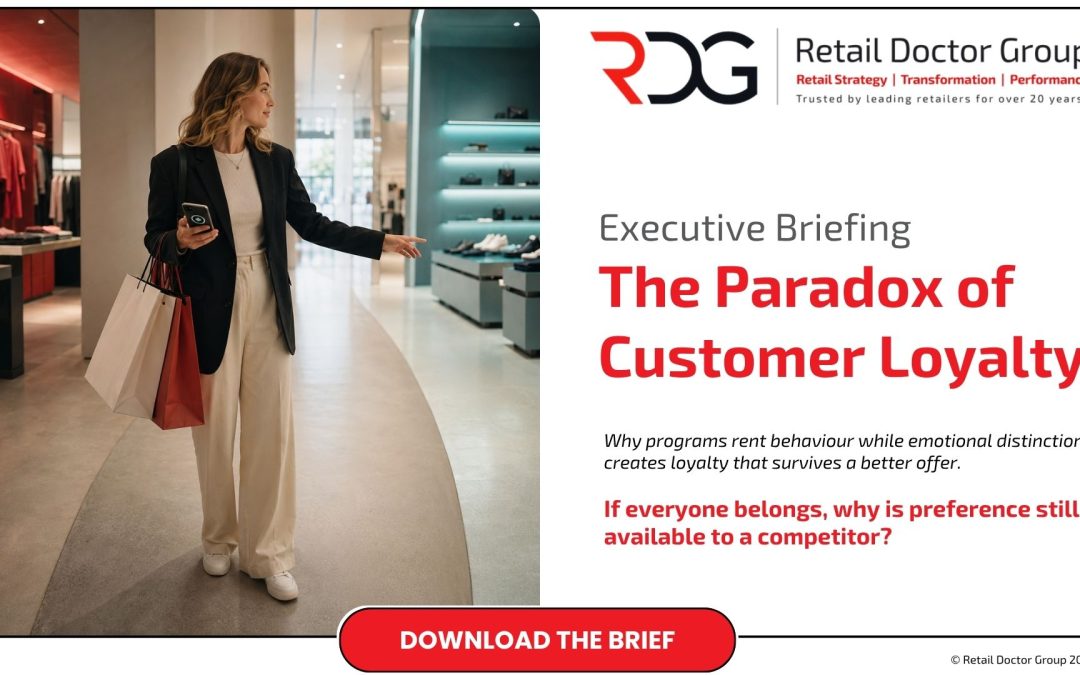
Retailers have spent years investing in loyalty programs, points, member pricing, rewards, offers, personalisation, and convenience. These mechanics can influence behaviour. They can encourage repeat visits, increase program activity, shape shopping timing, and help consumers recognise visible value. They do not automatically create true loyalty. That’s the paradox at the centre of RDG’s The Paradox of Consumer Loyalty executive webinar.
Watch The Paradox of Consumer Loyalty Replay
Watch RDG’s The Paradox of Consumer Loyalty executive webinar to understand how loyalty programs can move beyond participation and build the emotional distinction that turns activity into preference, and preference into commitment.
The CEO Dilemma
RDG’s proprietary 2026 research, based on a nationally representative sample of 1,000 Australian consumers, shows that 97% of consumers already belong to a loyalty program. Yet true loyalty remains in the minority. Program participation is high, but preference is still available to a competitor when the offer becomes easier, cheaper, or more rewarding.
The CEO dilemma is clear: loyalty is becoming more measurable, and more contestable.
Program activity is rising faster than loyalty is being secured. Compared to six months ago, 35% of consumers are using loyalty programs more often, 54% are using them about the same, and 11% are using them less. At the same time, 48% would switch to another similar brand if its loyalty program offered better value or benefits.
Activity Is Not Commitment
This reveals the difference between activity and commitment.
A consumer may use a program, collect points, redeem rewards, respond to offers, or shop more often. That behaviour matters commercially, but it does not prove emotional preference. If the same consumer moves the moment another retailer improves the value exchange, the program has rented behaviour rather than earned loyalty.
The Three Levels Of Loyalty
RDG’s executive webinar reframes loyalty across three levels:
- Transactional loyalty is driven by price, points, savings, rewards, and immediate value. It can buy the next transaction, but it is easy for competitors to copy.
- Behavioural loyalty is driven by convenience, habit, ease, routine, and shopping familiarity. It can create momentum, but it remains vulnerable when another retailer removes more friction or offers a better experience.
- Emotional loyalty is different. It is preference built through the brand, the experience, recognition, relevance, trust, identity, belonging, confidence, and care. It is the form of loyalty that survives competitive pressure.
What Consumers Say Loyalty Means
Consumers describe loyalty programs most often through rewards and freebies, with 52% mentioning immediate rewards, 33% mentioning discounts and added value, and only 8% describing loyalty as feeling valued. This does not mean emotional loyalty is absent. It means the transactional layer is often the most visible.
Retailers still need to make the value exchange clear. Consumers need to see what they get, how to earn it, and how to use it. But visible value is only the entry point.
Brand And Experience Create The Reason To Choose
Brand and experience create the stronger reason to choose. RDG’s research found brand look and feel at 55% and in-store experience at 38% were stronger stated reasons for loyalty than program membership at 32% or lowest price at 28%.
A loyalty program can reinforce a differentiated proposition. It cannot continually compensate for a weak brand, poor experience, or unclear reason to prefer the retailer.
Where RDG Limbic Insights™ Changes The Conversation
Limbic Insights™ identifies what priority consumers need to feel before they choose, stay, and return. Different consumer mindsets respond to different emotional triggers, so the same loyalty mechanic cannot be framed the same way for everyone. Some consumers need certainty and proof. Some need progress and recognition. Some need discovery, flexibility, care, or stability.
The practical opportunity is to turn the emotional reason to stay into a loyalty operating plan.
That means identifying the Limbic segments that matter most to growth and profit, defining the emotional ground the brand should own, translating that into loyalty design, embedding it through experience and communication, and measuring whether preference and resilience are improving retention, margin, customer acquisition payback, and lifetime value.
Next Steps for Retail Leaders
The strongest loyalty question for retailers is no longer who has joined. It is who would still choose the brand if a competitor offered more.
Retailers need to move beyond demographics and identify which customer types their brand attracts and why they choose.
The next step is to define the emotional role the brand plays, translate that WHY into priorities, messaging, proof points, service, and loyalty strategy, then measure whether customers trust the brand, feel confident to choose, and are willing to pay more and return.
Retail Doctor Group helps retailers identify customer tribes, define emotional territory, activate insights across the retail model, measure emotional performance, and turn customer understanding into growth.
Download the Paradox of Consumer Loyalty Executive Brief
Download the executive brief to understand the three commercial questions every retail CEO must answer, and assess where emotional insight can strengthen preference, resilience, retention, customer value, margin protection, and loyalty program ROI.
Speak to a Limbic Insights™ retail expert today. Contact the team for your complimentary consult now.
☎ +61 2 9460 2882
✉ businessfitness@retaildoctor.com.au
🌐 retaildoctor.com.au